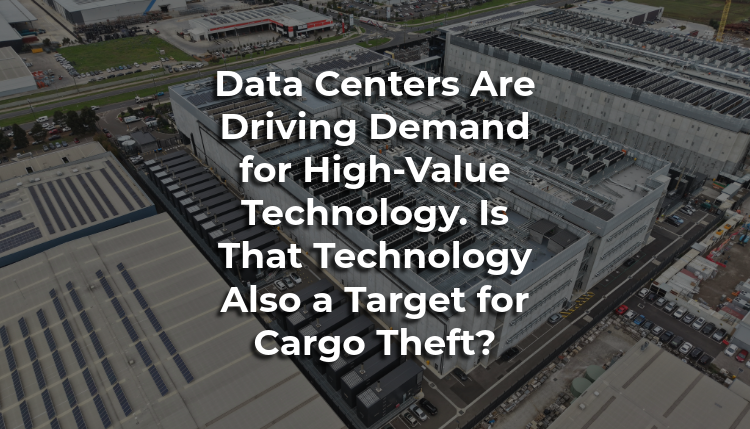
The data center industry is growing at an incredible pace and many builders aren’t aware of the cargo insurance that is needed to protect the materials that are used to make these massive centers.
Artificial intelligence, cloud computing, streaming, enterprise software, and the continued expansion of digital services are driving billions of dollars in investment into new data centers across the United States and around the world. Building these facilities requires much more than concrete, steel, and a large building.
Modern data centers depend on sophisticated technology and specialized equipment to provide the computing power, electrical capacity, cooling, connectivity, and redundancy needed to keep them operating around the clock.
That means a lot of extremely valuable equipment is moving through the supply chain. For data center builders, contractors, and equipment suppliers, that raises an important question: Is the technology being shipped to data centers the same type of technology that cargo thieves are targeting?
Increasingly, the answer appears to be yes.
What Technology Goes Into a Data Center?
A modern data center is essentially a massive ecosystem of interconnected technology. Some of the most important equipment includes:
Servers and AI Hardware
Servers are the heart of a data center. They house the processors, memory, storage, and other components that perform the computing work.
The growth of artificial intelligence has added another layer to this demand. AI-focused data centers require large quantities of specialized GPUs, accelerators, server blades, and other high-performance computing components. These components can be extremely valuable while being relatively compact compared with other data center equipment.
That combination matters when considering cargo theft.
Networking Equipment
Servers need to communicate with each other and with the outside world.
Data centers therefore rely on large quantities of networking equipment, including switches, routers, fiber-optic transceivers, and other connectivity hardware. Some of these components can carry significant value in relatively small packages. That makes them a very different transportation risk from something like a large generator or transformer.
Storage Equipment
Data centers also require enormous amounts of storage. This can include storage drives, solid-state drives, hard drives, storage arrays, and other specialized equipment. Again, these products can be expensive, technologically sophisticated, and relatively easy to transport.
Power Infrastructure
A data center cannot operate without reliable electricity.
Large facilities can require extensive electrical infrastructure, including:
- Transformers
- Generators
- Uninterruptible power supplies
- Switchgear
- Power distribution units
- Battery systems
- Busways and electrical distribution equipment
These components can be worth hundreds of thousands or even millions of dollars.
However, they present a different theft profile than smaller electronics. A large transformer or generator may have significant replacement value, but its size and weight make it considerably more difficult to steal than a pallet of high-value electronic components.
Cooling Systems
Data centers generate enormous amounts of heat, particularly facilities designed to support high-density computing and AI workloads.
Cooling technology can include chillers, cooling towers, pumps, heat exchangers, air-handling systems, and increasingly, liquid-cooling systems. As AI infrastructure becomes more powerful, cooling requirements are changing as well.
That means new generations of specialized cooling technology are becoming an increasingly important part of data center construction.
Is Data Center Technology Actually Being Stolen?
This is where the data becomes particularly interesting.
CargoNet’s recent cargo-theft reporting shows that organized criminal groups are targeting enterprise-grade computer and networking equipment, along with components and cryptocurrency mining hardware. CargoNet has specifically identified items such as RAM modules, fiber-optic transceivers, storage drives, and enterprise server blades as targeted commodities.
The connection to data centers is significant.
These are not simply generic consumer electronics. They are the types of high-value computing and networking components that can be found throughout modern data center infrastructure.
CargoNet’s 2025 reporting also identified enterprise computing hardware as a top-tier target for organized criminal groups. In its Q3 analysis, CargoNet noted that enterprise servers, components, and cryptocurrency mining hardware were being shipped as standard dry goods even when individual shipments were valued in the millions.
That creates an important mismatch:
The cargo may be worth millions of dollars, but it may not look like a multimillion-dollar shipment.
Why Would Thieves Target Data Center Technology?
Cargo thieves aren’t necessarily looking for the most expensive item on a truck.
They are looking for cargo that combines value with opportunity.
Several characteristics can make technology attractive:
- High value relative to size
- Strong resale demand
- Easy movement
- Difficult-to-track components
- Large quantities moving through major freight corridors
- Potential for fraudulent pickup or shipment diversion
This is particularly relevant for servers, components, networking equipment, and other high-value electronics.
CargoNet’s 2025 analysis found that organized criminal groups increasingly focused on high-value shipments, with the estimated average theft value reaching $273,990 and total estimated losses approaching $725 million.
By 2026, CargoNet was reporting an average stolen commodity value of approximately $341,518 during the first half of the year, while continuing to identify enterprise computer and networking components among targeted commodities.
For data center builders, those numbers are worth paying attention to.
The Risk Isn’t Limited to AI Chips
It can be tempting to think of the data center cargo exposure as being primarily about expensive GPUs.
But the supply chain is much broader than that. A data center project may involve shipments of servers, RAM, storage drives, networking equipment, fiber-optic components, electrical equipment, cooling systems, batteries, and other specialized hardware.
Some of those products may be highly attractive to thieves because of their size and resale potential. Others may be less attractive because they are extremely large or difficult to move. That means a data center builder shouldn’t necessarily treat every shipment the same way.
The value, size, commodity, route, and replacement time of each shipment can all influence the risk.
What Happens If the Equipment Is Stolen?
Consider a hypothetical shipment containing $2 million worth of server and networking equipment.
The immediate problem is obvious: $2 million in cargo is gone. But the potential impact doesn’t necessarily end there.
- What if the equipment has a long lead time?
- What if the manufacturer has already allocated its available inventory to other customers?
- What if the project has an installation schedule that depends on the equipment arriving on time?
The financial impact of the loss can potentially extend into project delays, expedited transportation, additional labor, storage, replacement costs, and other expenses.
For a major data center project, a transportation loss can become a project-management problem very quickly.
Shipment-by-Shipment or Annual Cargo Insurance?
This brings us to an important question for data center builders:
What type of cargo insurance makes the most sense?
There isn’t one answer for every company.
The choice between shipment-by-shipment coverage and an annual cargo insurance policy generally comes down to how frequently a company ships, how predictable its shipping activity is, and how much cargo is moving through the supply chain.
Shipment-by-Shipment Cargo Insurance
Shipment-by-shipment coverage allows a company to insure individual shipments as they occur.
This can make sense for a data center builder that:
- Has relatively few shipments
- Is working on an isolated project
- Has highly variable shipment values
- Does not regularly import or transport cargo
- Wants to insure a particularly high-value shipment
For example, if a contractor is importing one specialized shipment of AI servers valued at several million dollars, shipment-specific coverage may be worth considering.
The downside is administration.
If a company is moving dozens or hundreds of shipments throughout a project, individually arranging coverage can become cumbersome.
There is also the possibility of an individual shipment being overlooked.
Annual Cargo Insurance
An annual cargo insurance policy provides ongoing coverage for qualifying shipments throughout the policy period. For a data center builder moving equipment regularly, this can be a much more practical approach.
An annual policy may be particularly worth considering when a company has:
- Multiple data center projects
- Frequent international shipments
- Frequent domestic shipments
- Multiple suppliers
- High annual cargo values
- Equipment moving through different transportation modes
- A continuing need for cargo coverage
Instead of stopping to arrange insurance for every shipment, the company can establish an insurance program designed around its overall shipping activity.
TRG Marine offers annual cargo insurance designed around a company’s shipping profile, with coverage options that can include warehouse-to-warehouse transportation and domestic or warehouse extensions where applicable.
Which Is Better for a Data Center Builder?
For a company building a single data center and importing only a handful of high-value shipments, shipment-by-shipment insurance may be worth evaluating. For a company that builds multiple data centers and continuously moves equipment, an annual policy will often be the more practical solution.
The reason is simple:
The more frequently you ship, the harder it becomes to manage cargo insurance one shipment at a time. An annual policy can provide continuity and reduce the administrative burden of arranging coverage repeatedly. But the decision should be based on the actual shipping operation rather than simply assuming an annual policy is always better.
The right questions include:
- How much cargo are we moving each year?
- How many shipments are we making?
- What types of equipment are we shipping?
- Where are those shipments coming from?
- What transportation modes are involved?
- How long would it take to replace the equipment?
- Where does our responsibility for the cargo begin and end?
These questions help determine what type of coverage makes sense.
Data Center Builders Should Look Beyond the Purchase Price
One of the biggest mistakes a company can make when evaluating cargo risk is focusing only on the invoice value.
The real exposure may be much larger. A $1 million shipment that can be replaced in a week presents one type of risk. A $1 million shipment containing specialized equipment with a six-month lead time presents another.
For data center builders, the question should therefore go beyond:
- “How much is this shipment worth?”
It should also be:
- “What happens to our project if this shipment doesn’t arrive?”
Protecting the Technology Behind the Data Center
Data centers are being built to support some of the most important technology in the modern economy.
But before the servers are installed, AI models are running, and the facility is connected to the network, all of that equipment has to get there. And increasingly, some of that same high-value technology is becoming a target for organized cargo thieves.
Enterprise servers, networking equipment, storage drives, fiber-optic components, and other computing hardware have all appeared in recent cargo-theft reporting. For data center builders, cargo insurance can provide an important layer of protection against covered physical loss or damage while equipment is in transit. The right insurance strategy may depend on how the company operates.
For a builder moving occasional, project-specific equipment, shipment-by-shipment coverage may be appropriate. For a company continuously moving high-value equipment across multiple projects, an annual cargo insurance program may provide a more practical solution.
The data center boom is creating enormous demand for sophisticated technology. That technology doesn’t become valuable only when it reaches the data center.
It is valuable from the moment it starts moving.
![[Video] Identifying Mistaken Entries on Your Bond](https://traderiskguaranty.com/trgpeak/wp-content/uploads/2026/10/EP14-YouTube-Featured-Image-400x250.png)