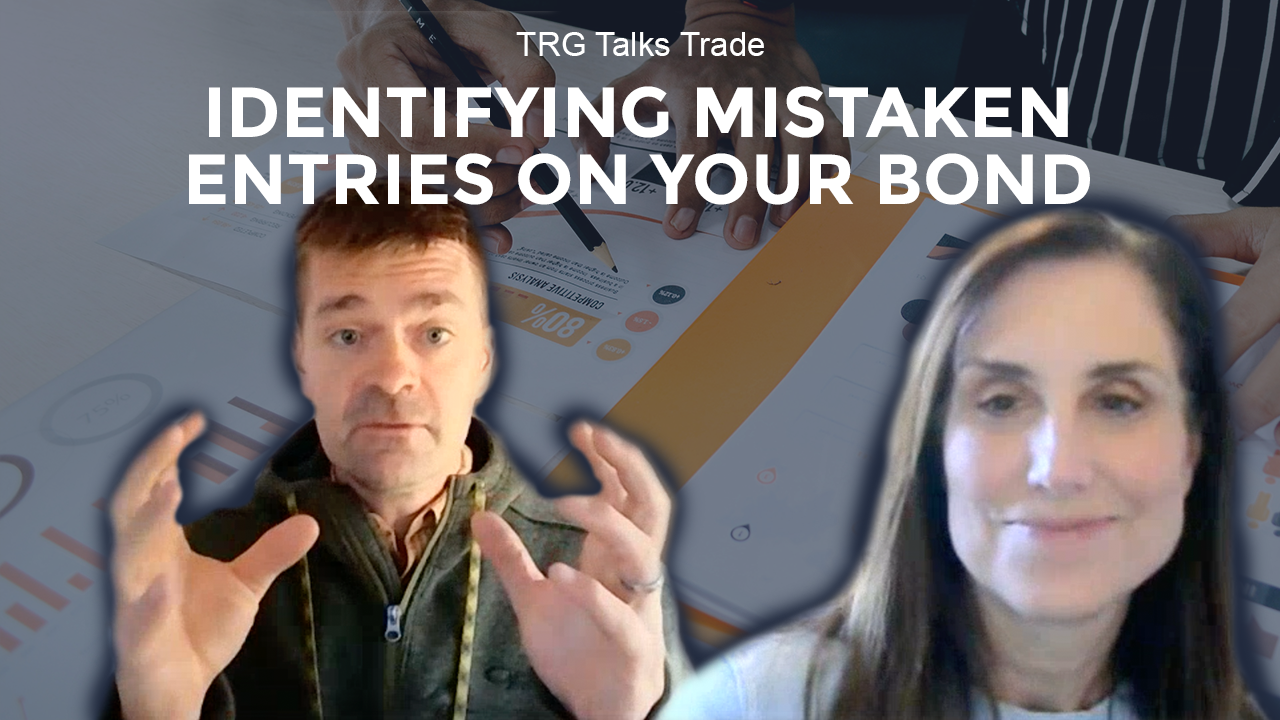
Travis Smith and Colette Lang discuss how TRG’s compliance software can help an importer identify mistaken entries on your bond.
The process of shipping and importing goods brings with it a high amount of risk and uncertainty. And while companies can do everything in their power to ensure they are compliant with U.S. Customs and Border Protection, what can you do if a mistake is made that is beyond your control?
An Antidumping/Countervailing Entry Made On Your Bond by Mistake
This story begins when the importer saw that an entry made on their U.S. Customs Bond was flagged as an Antidumping/Countervailing (AD/CV) entry. However, this particular importer does not import any commodity currently subject to antidumping and/or countervailing.
So how did this happen? Well there are a couple potential reasons an AD/CV entry could suddenly be made on your bond:
- You started importing a new commodity that is subject to antidumping/countervailing
- The commodity you have been bringing in is newly subject to antidumping/countervailing
- A mistake was made when filing the entry
It is important to identify which of these reasons apply to your entry so that you can know what your next steps should be.
Identifying Mistaken Entries on Your Bond
The importer was quickly able to identify that a mistake was made when they saw a claim issued on their bond through TRG’s Eagle Eye ACE reporting. Once they saw that this claim had to do with antidumping/countervailing, they knew they had to investigate further as they do not import goods subject to AD/CVD.
A member of the TRG team, Colette Lang was walking through their data with them and identified that this entry was made using a filer code that had not made any other previous entries for them. The first 3 digits of the every entry number, identifies the Customs broker that filed the entry (these 3 digits are known as the filer code). After looking up the filler code, they were able to identify exactly who the Customs broker that filed the entry was.
At this point the importer realized they had never done business with the broker that filed that entry. They then called the broker to ask why this entry was made using their bond number.
In the end, the importer and the broker were able to identify that when this specific entry was made, the wrong bond number was used on the paperwork. The broker was able to file a correction and get the antidumping/countervailing entry removed from the importer in question’s Customs bond.
TRG Discusses the Importance of Identifying Mistaken Entries on Your Bond
In a new episode of TRG Talks Trade Travis Smith and Colette Lang discuss a real-world example of how TRG’s compliance software helped a U.S. importer identify an entry filled on their Customs bond by mistake.
This video covers the following topics:
- How the importer was able to flag the entry as suspicious
- How TRG helped the importer identify that it was a mistake
- The actions the importer was able to take to fix the error
As a reminder, this video is a discussion for educational purposes only and does not constitute legal advice.
Access Your Import Data for More Transparency
In this particular situation, the importer in question was a registered user of TRG’s Eagle Eye ACE compliance reporting which allowed them to easily identify the mistaken entries on their bond. Having access to their data meant that they were able see this mistake more immediately and take action to resolve the issue.
To get more transparency and answers from your data, learn more about Eagle Eye ACE.